AI Tool Consultant

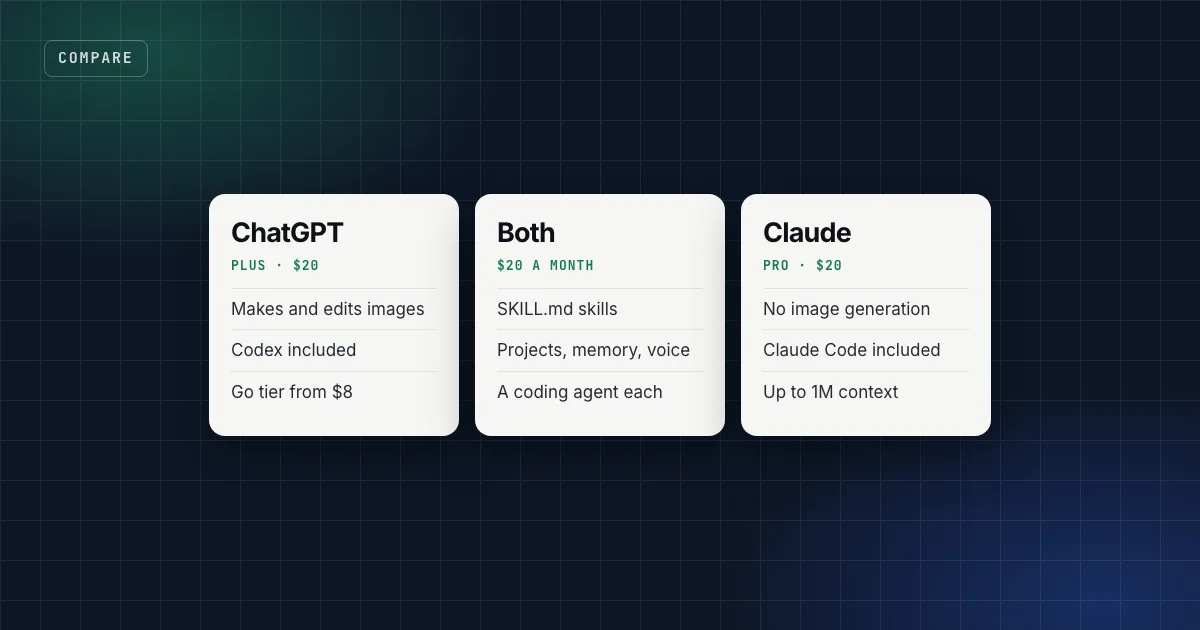
I pay for both: ChatGPT Plus and Claude Pro, $20 a month each. That's a choice plenty of people make and then question every month, so this page answers the question I'd ask before paying for either: what does each plan actually include, where do they really differ, and which kind of work leans which way?
The short answer
- Pick ChatGPT Plus if you want images made and edited in the same app, if you'd use the desktop app's voice and computer use, or if $8 for the Go tier covers what you need.
- Pick Claude Pro if you work through long documents and source packs (up to 1M tokens of context on every plan, model permitting), or if Claude Code is the coding agent you'd use.
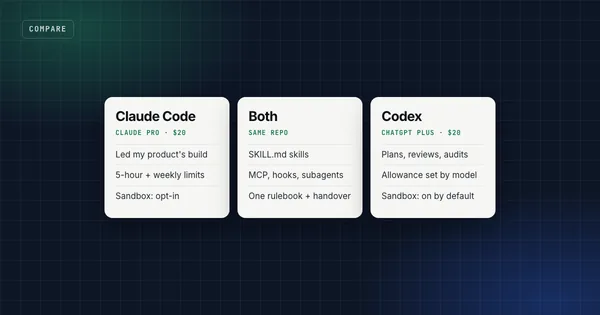
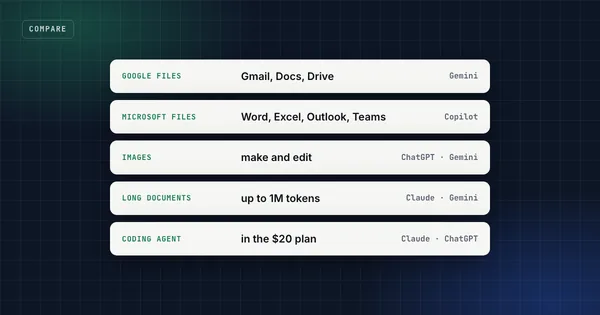
- Pay for both only if you use both coding agents or keep hitting one plan's limits. Most of the overlap is large: projects, memory, voice, web search, files, skills and a coding agent come with both.
Quick decision guide
| If your work is mostly... | Lean | Why |
|---|---|---|
| Social posts, slides and pages that need images | ChatGPT | It generates and edits images; Claude doesn't make photos or illustrations.3 6 |
| Long reports, contracts, research packs | Claude | Up to 1M tokens of context on every plan, depending on the model.1 |
| Building software | Either, by coding agent | Plus includes Codex, Pro includes Claude Code; I compared them side by side. |
| Repeating the same workflow every week | Either | Both run skills in the open SKILL.md format, so one skill can serve both.1 5 |
| Trying AI on a small budget | ChatGPT Go or either free plan | Go costs $8; both have free plans with limited usage.1 2 |
| A team of 2 or more | Either | ChatGPT Business and Claude Team both cost $20 per seat a month billed annually, $25 monthly.1 2 |
ChatGPT Plus vs Claude Pro at a glance
| ChatGPT Plus | Claude Pro | |
|---|---|---|
| Price | $20 a month2 | $20 a month, or $17 a month billed annually1 |
| Cheaper paid tier | Go, $8 a month2 | None; Free is the step below1 |
| Next tiers up | Pro at $100, $200 or $500 a month2 | Max $100, Ultra $200 a month1 |
| Coding agent included | Codex: web, CLI, IDE extension, iOS2 | Claude Code: terminal and IDEs4 |
| Image generation | Yes, generate and edit6 | No photos or illustrations; diagrams, charts and interactive visuals in chat (beta)3 |
| Skills (SKILL.md) | In the desktop app and Codex; skills inside plugins also on web and mobile5 | Yes, on every plan including Free1 |
| Context window | Not published on the pages I read | Up to 1M tokens, varies by model1 |
| Voice | Voice in the desktop app on Plus and above7 | Voice mode on every plan1 |
| Acting in your browser or on your computer | Computer use in the desktop app8 | Claude in Chrome, from Pro1 |
| Limits | Agentic work and Codex share one allowance, set by model2 | A 5-hour and a weekly limit, shared with Claude Code4 |
| Team plan | Business: $20 per user a month billed annually, $25 monthly2 | Team: $20 per seat a month billed annually, $25 monthly1 |
Projects, memory, web search, file uploads and connectors to other apps are on both sides, which is why the rows above are the ones worth deciding on.
Where they really differ
1. Images are ChatGPT's alone
ChatGPT generates images and edits images you give it, inside the chat.6 Anthropic's own help centre says Claude doesn't generate photos or illustrations; it builds diagrams, charts and interactive visuals from HTML and SVG instead, a feature in beta on web and desktop.3 If your week includes a thumbnail, a slide picture or a product mock-up, that alone can decide it. In Codex and ChatGPT's agentic Work mode, OpenAI says image generation uses the included limits 3 to 5 times faster than a similar turn without it.2
2. Each plan includes a different coding agent
Plus includes Codex and Pro includes Claude Code, so the $20 plan is also a choice of coding agent. On Terminal-Bench 4.0, which names the agent next to the model, Claude Code with Opus 5.5 completed 64.8% of tasks and Codex's best runs 58.2% (read 1 November 2026).9 The full comparison, including what happened when both worked on the same feature in my app, is in Claude Code vs Codex.
3. What shares your limits
On Claude Pro, chat and Claude Code draw on the same 5-hour and weekly limits, so a long coding session leaves less for writing that afternoon.4 On ChatGPT Plus, OpenAI's docs say ChatGPT's agentic Work mode and Codex share one allowance, and how far it stretches depends on the model you pick: their estimate for local Codex messages ranges from 5 to 45 per five hours with GPT-6 Astra to 350 to 3,000 with GPT-6 Luna.2 Neither company publishes a fixed message count for the $20 chat plan on the pages I read.
4. Skills work in both now
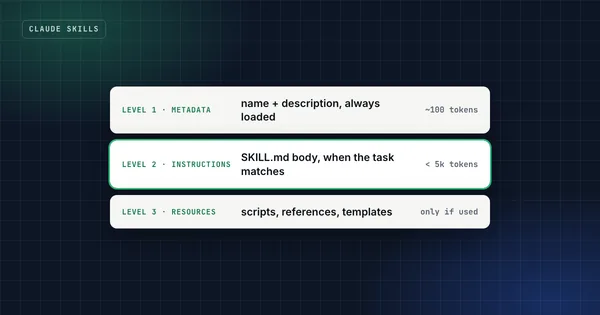
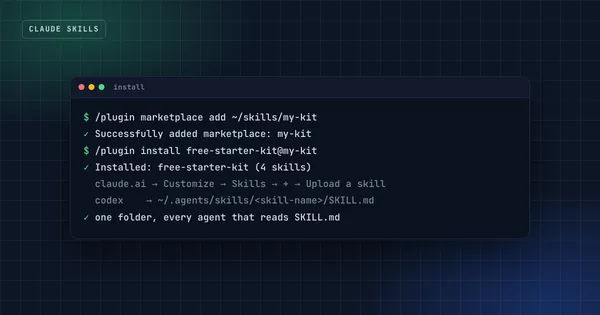
Claude's Skills and ChatGPT's skills follow the same open agent skills standard: a folder with a SKILL.md file, plus optional scripts and references.5 In Claude you upload a skill as a zip (Customize, then Skills) on any plan.1 In ChatGPT, standalone skills run in the desktop app and in Codex, and skills packaged in plugins also work on the web and mobile.5 That's useful if you're unsure: a workflow you write once isn't locked to one vendor.
5. The tiers around $20
Below $20, ChatGPT has Go at $8; Claude goes straight from Free to Pro. Above it, both start at $100, but OpenAI's Pro tops out at $500 with an Ultrafast mode, while Claude's top individual plan is Ultra at $200, with no 5-hour limit for verified accounts.1 2
How I split the work
My records since spring 2026 show a pattern I didn't plan:10
- ChatGPT conversations often end in Codex. Many of my Codex threads start from a ChatGPT conversation or project: I think something through in the chat, then hand it to the agent to do.
- Claude carries the repeatable workflows. Several of my own skills live in my Claude account, among them captions, video-editing routines, my German journal correction and turning notes into documents. Claude Code built this site and writes most of my product's code.
- Both do language work. My German journal correction runs as a skill in Claude, while I've used Codex for German and French practice too.
That's one person's habit, not a ranking. It does show where each tool earned its place for me: ChatGPT as the place to think out loud and make images, Claude as the place where a written-down method runs the same way every time.
What the benchmarks say
Public boards rank models, not the apps around them, and they move every week.
- arena.ai's WebDev board, built from people's votes between two anonymous front-end builds, had Claude Opus 5.5 first and OpenAI's GPT-6 Astra second at its 27 October 2026 update.11
- Terminal-Bench 4.0, which tests the coding agents themselves, put Claude Code ahead of Codex (64.8% against 58.2% of tasks, 1 November 2026).9
- Neither board measures image generation, where only ChatGPT has the feature, or the plan limits, which decide more of your day than a few points of preference.
Test it on your own work
A ranking won't tell you which assistant fits your tasks. Three tests will, and each takes ten minutes in both apps:
- A post in your voice. Give both the same facts from your own work and the same voice rules (or the same skill), and ask for a LinkedIn post. Judge it before you see which app wrote which: does it sound like you, and did it invent anything?
- A correction with an answer key. Take a paragraph with mistakes you already know (a language you're learning, or a document with known errors). Count what each fixed, what it missed, and what it changed that was already right.
- One real chore. Captions for a post, a meeting summary, a cleanup of a spreadsheet you actually have. The free caption skill in my starter kit works in both apps, so you can run the identical instructions.
Write the criteria down before reading the outputs. My kit for running these three with my own skills is ready; the results go on this page once both sides have run.
Where my skills fit
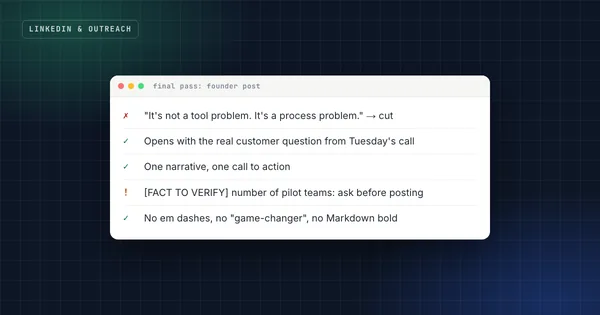
The packs I sell work in Claude and in ChatGPT's skill-capable surfaces alike, because they're plain SKILL.md folders: the LinkedIn ghostwriter writes in your voice from your facts, the German writing correction corrects without rewriting what was right, and the caption writer is free in the starter kit. A skill moves your method between tools; it never decides which tool wins.
FAQ
Is Claude better than ChatGPT?
For some jobs, yes: long documents (up to 1M tokens of context on every Claude plan, model permitting) and coding with Claude Code, which leads the agent benchmark I checked. For others, no: Claude doesn't generate images, and ChatGPT has a cheaper $8 tier. For everyday writing and questions the documented differences are small, so test both on your own tasks (see above).
Is ChatGPT better than Claude for coding?
Both $20 plans include a coding agent, Codex with ChatGPT and Claude Code with Claude. On Terminal-Bench 4.0 (1 November 2026), Claude Code with Opus 5.5 completed 64.8% of tasks and Codex's best runs 58.2%. In my own work Claude Code became the main builder and Codex the reviewer; the details are in Claude Code vs Codex.
Which is cheaper, ChatGPT or Claude?
The main plans cost the same, $20 a month, and Claude Pro drops to $17 a month billed annually. ChatGPT has a cheaper paid tier, Go, at $8. The next tiers start at $100 on both sides.
Can Claude generate images?
No. Anthropic says Claude doesn't generate photos or illustrations; it can build diagrams, charts and interactive visuals in the chat (in beta) and analyse images you upload. ChatGPT generates and edits images.
What are the usage limits on ChatGPT Plus and Claude Pro?
Claude Pro has a 5-hour session limit and a weekly limit, shared with Claude Code; Anthropic doesn't publish a message count. On ChatGPT Plus, agentic work and Codex share an allowance that depends on the model; OpenAI publishes ranges for Codex, such as 15 to 160 local messages per five hours for GPT-6.1 Sol. Both ran out for me at times in October.
Do Claude skills work in ChatGPT?
Yes, if they follow the open SKILL.md format. ChatGPT runs standalone skills in its desktop app and in Codex, and skills inside plugins on the web and mobile. Claude runs them on every plan, uploaded as a zip.
Which is better for writing?
I haven't published a side-by-side writing test yet; the three tests above are how I'm running it. What's documented today: Claude offers up to 1M tokens of context on every plan, useful for long drafts and source material, and both can carry your voice rules as a skill, so the instructions that define your voice travel with you.
Sources
- Pricing, Anthropic (read 1 Nov 2026).
- Pricing, OpenAI's ChatGPT and Codex documentation (read 1 Nov 2026).
- Can Claude produce images?, Claude Help Center (16 Mar 2026).
- Use Claude Code with your Pro, Max, or Ultra plan, Claude Help Center.
- Build skills, OpenAI documentation, and Agent Skills, the open standard.
- Image generation, OpenAI documentation.
- ChatGPT Voice, OpenAI documentation.
- Computer use, OpenAI documentation.
- Terminal-Bench 4.0 leaderboard (read 1 Nov 2026).
- My usage records: Codex threads and the skills in my Claude account, read 1 Nov 2026.
- WebDev leaderboard, arena.ai (updated 27 Oct 2026, read 1 Nov 2026).
LinkedIn Ghostwriting & Outreach
Write in a real person's voice, report what LinkedIn actually did, and run outbound that doesn't burn your domain.
Get the free starter kit
Four skills that work in Claude, Claude Code and Codex alike: handover, session start, social captions and an honest exam-prep tutor. Free, so you can judge the standard.