AI Tool Consultant

At a B2B start-up I write LinkedIn posts for two founders and for the company page. Left without guidance, an AI draft fails in the same few ways: the same shape every time, a hook built on "It's not X. It's Y.", a lesson at the end that the person never actually had. Nobody would call those drafts bad. Everybody scrolls past them.
Writing LinkedIn posts with Claude that sound like a person comes down to three things: give Claude the person's real voice, give it only verified material, and remove the patterns readers associate with AI. This is the method I use for that work.
At a glance
- Build a voice profile first from 5–15 of the person's past posts, transcripts or talks. Without one, Claude writes in its own voice.
- Ask one question before drafting: is this post promotional, educational or personal? Keep the answer through every edit.
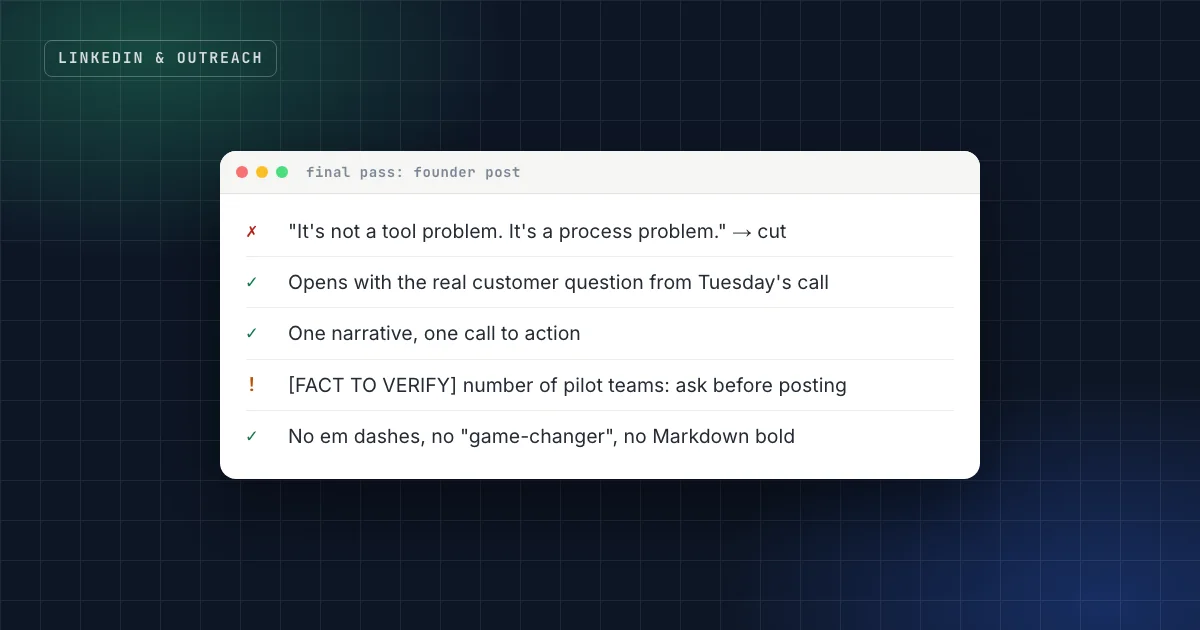
- Never let Claude invent quotes, lessons, numbers or customer results. Missing facts get marked
[FACT TO VERIFY]. - Remove the AI tells: the "It's not X. It's Y." hook, em dashes, words like "game-changer", the same structure every time.
- Several voices at one company need different angles on the same news, not the same post with swapped words.
Why do AI-written posts stand out?
Because they fail in predictable ways, and readers now know the patterns:
- Every post has the same structure: a punchy hook, a story, three bullets, a lesson, a P.S.
- The hook is a template, most often the oppositional "It's not X. It's Y."
- A lesson appears that the person never had. "What this taught me…" followed by a neat moral nobody stated.
- Numbers and quotes appear from nowhere, chosen because they make the point land.
- The language is generic: "unlock", "seamless", "game-changer", "in today's fast-paced world".
None of these is a grammar problem, so a proofreading pass won't catch them. They're voice and integrity problems, which is why the fix starts before the first draft.
Step 1: build a voice profile
A voice profile is a short file per person that describes how they actually write, built from 5 to 15 of their past posts, transcripts or recorded talks. It records things like:
- How they open: a question, a scene, a number, a blunt statement.
- Sentence length and rhythm, and whether they use humour.
- Words they use and words they'd never use.
- What they talk about from experience, and what they don't claim.
- How they end: a question, a call to action, or just stopping.
Keep one file per person (for example voices/<name>.md) in a Claude project or a repository, and make the profile the first thing Claude reads before drafting. When two sources disagree, the order that keeps posts safe is: the person's explicit request and material, then facts verified for this post, then the brand guide for product facts and claims, and only then the voice profile. Never bend a product fact to sound more personal.
Step 2: ask the category question
Before drafting, ask: is this post promotional, educational or personal?
- Promotional shows real product value.
- Educational teaches something useful.
- Personal centres on the person's verified experience or reflection.
The answer decides the shape, the call to action and how much product appears. Mixing all three in one post is the most common reason drafts feel unfocused. A weekly mix of one of each is a reasonable editorial intention; judge it on the account's own results (replies, qualified conversations), not reach alone.
Practical takeaway
Give Claude one central narrative per post. A post that tries to be a biography, a product tour, an event recap and a sales pitch at once reads like a press release.
Step 3: draft from verified material only
This is the rule that protects the person you write for: never invent quotes, experiences, lessons, dates, metrics, product capabilities or customer outcomes. If a material fact is missing, Claude writes around it or marks it:
We started with [FACT TO VERIFY: number of pilot teams] teams in the first month.The marker is visible and impossible to publish by accident. A plausible guess, by contrast, looks finished and can end up in front of the person's whole network. Two more integrity rules:
- Inferred lessons get flagged outside the post for the person to confirm. "It sounds like this taught you X. True?" is a question, not a sentence in the draft.
- Proofreading means proofreading. When someone asks you to check their draft, fix spelling, punctuation and grammar, and keep their structure, examples and opinions.
Step 4: remove the AI tells
Do a final pass with a fixed list. The constructions that most often give a post away:
| Avoid | Do instead |
|---|---|
| "It's not X. It's Y." and "You don't have an X problem. You have a Y problem." | State Y directly, with a concrete example |
| Em dashes (—) | A full stop, a comma or a colon |
| Three-item rhythm everywhere ("faster, smarter, better") | As many items as the content actually has |
| "Here's the thing:", "Let that sink in.", "Read that again." | Delete; the next sentence should carry the weight |
| A P.S. and a neat moral on every post | End on the concrete consequence or a real question |
| game-changer, revolutionary, unlock, seamless, leverage, delve | The plain word for what actually happened |
| Markdown bold | Plain text; LinkedIn shows the asterisks |
And a check against the person's own history: the structure should differ from their last three posts. A series of posts that all open with a question and close with "What do you think?" becomes its own template.
Several voices at one company
When a founder and a co-founder both post about the same launch, the worst outcome is two versions of one post. Give each a different angle on the same news. For example, one leads with the customer's pain and the commercial consequence; the other explains the product decision and what changed during the build. Vary the hooks, the paragraph order and the closings across the series, so a reader who follows both people sees two perspectives, not one script.
Format and visuals
- Short paragraphs and generous line breaks. Usually under 1,200 characters, but a verified story can take the room it needs.
- Optimise the first two or three lines, which are all most people see before "see more". The exact cut-off varies by device, so don't chase a character count.
- No more than two emojis, unless that's the person's style.
- For images, prefer a real photo of the person in the moment described, then real team or product images, then a clean branded visual. Generic AI imagery next to a personal story undermines it.
Measure what matters
Reach is the easiest number to watch and the least useful on its own. For a founder's account, the questions that matter are whether posts start conversations: replies from the right people, messages, demo requests. And if you report on a company page, read every tab of the export. A monthly report that looked only at followers once pointed the opposite way from the visitor data.
FAQ
Can Claude write LinkedIn posts in my voice?
Yes, if you give it your voice. A profile built from your own posts or talks, plus the material for the specific post, gets you drafts you'd actually publish. Without it, you get Claude's default voice, which readers increasingly recognise.
How do I make AI-written posts not sound like AI?
Remove the recognisable constructions (the "It's not X. It's Y." hook, em dashes, buzzwords, identical structure), and never let the model invent lessons or numbers. The second matters more: an invented detail is what makes a post feel hollow.
Is it OK to use AI for ghostwriting?
Ghostwriting was common long before AI. What matters is that the post reflects the person's real experience and views, that they approve it, and that nothing in it is invented.
Should I put links in the first comment?
It's a common practice and a matter of preference; if you do, keep the link out of the post itself and say in the post where to find it.
LinkedIn Ghostwriting & Outreach
Write in a real person's voice, report what LinkedIn actually did, and run outbound that doesn't burn your domain.
Get the free starter kit
Four complete skills for Claude, Claude Code and Codex: handover, session start, social captions and an honest exam-prep tutor. Free, so you can judge the standard.