AI Tool Consultant

In one B2B SEO program I worked on, about 80% of the keywords the team had brainstormed had no measurable search volume. A keyword that an older strategy document had ruled out as "too competitive" turned out to have a difficulty of 1, and became one of the best targets. Nobody had checked.
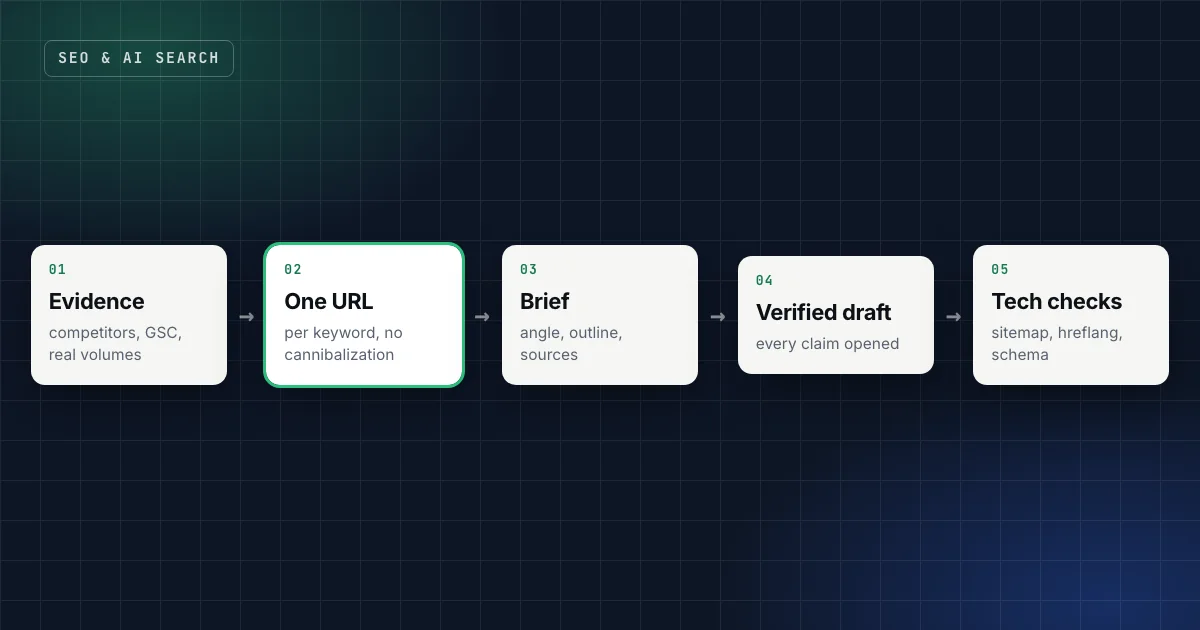
That's the core lesson of using Claude for SEO. Claude is excellent at structure, drafting, clustering and code. It has no live search data, so it can't tell you what people search for, how hard a keyword is, or what currently ranks. A good workflow splits the work accordingly: evidence from real tools, method and drafting from Claude, verification from you.
At a glance
- Claude doesn't know search volumes. Without a tool, any number it gives is a guess. Start from Search Console, competitor rankings and keyword tools.
- One keyword, one URL. Two of your pages competing for the same query split the signals and both lose.
- Verify every claim against a page you opened. A link that loads doesn't prove the page says what you claim.
- Google rewards helpful content "however it is produced", and treats mass-produced pages made to manipulate rankings as spam.1 2
- Claude Code is worth it for technical checks: sitemaps, hreflang, structured data, internal links.
What is Claude good at in SEO, and what isn't it?
| Claude is good at | Claude can't do on its own |
|---|---|
| Clustering keywords you give it by topic and intent | Telling you real search volumes or difficulty |
| Turning research into briefs and outlines | Knowing what currently ranks for a query |
| Drafting in a house style, with structure and FAQs | Guaranteeing facts are true or current |
| Writing scripts that audit sitemaps, hreflang and schema | Seeing your Search Console data unless you give it the export |
| Rewriting titles and meta descriptions for intent | Predicting rankings |
The left column saves hours. The right column is where AI-assisted SEO goes wrong: invented volumes, confident claims without sources, and articles that compete with the site's own pages.
Step 1: keyword research from evidence, not brainstorming
The best keywords are the ones already proven to drive traffic. In order of how much to trust them:
- Competitors' organic keywords. Export their top keywords by traffic from a tool such as Ahrefs or Semrush. These are proven queries.
- Broad seeds, then matching terms. Enter the category in two or three words, not guessed long-tails, and filter by volume and difficulty per language.
- Your own rankings. Queries where you're already on page two or three are easier to push up than starting from zero.
- Search Console. High impressions with low clicks is a title problem. High impressions at a low position is a content problem. New queries are emerging topics.
Then validate every candidate on the results page itself. In the same program, a broad term with difficulty 0 and decent volume looked like an easy win, until the results showed that about 90% of them were about a different industry. That traffic would never have converted. Two more checks paid off: cost per click as an intent signal (a high CPC means buyers are searching), and phrasing variants. "EU AI Act Article 50" turned out to be clearly stronger than "Article 50 AI Act", so the stronger form went into the heading.
Claude's job here is the analysis: give it the exports and ask it to cluster, flag intent mismatches and draft the shortlist. Its job is not to supply the numbers.
Practical takeaway
If you have no paid tool, use Search Console, Google's autocomplete, People Also Ask and competitors' sitemaps, and label every estimate as an estimate. A real query with unknown volume beats an invented volume for a query nobody types.
Step 2: one keyword, one URL
Keyword cannibalization is two of your own pages competing for the same query. Both get weaker. The fix is a rule and a ledger:
- Every primary keyword has exactly one owning URL, written down in a keyword registry.
- Before writing anything, check the candidate keyword against everything published, everything planned and every other brief.
- When a pillar page and a deep-dive overlap, the deep-dive takes the specific keyword, the pillar keeps the broad term and summarises with a link, and both link to each other. This is the hub-and-spoke model.
Claude is very good at this check if you give it the registry and your article index: "Does any published or planned page already target this keyword or a near variant?" It's tedious for a person and fast for Claude.
Step 3: briefs that make the article hard to get wrong
A brief is where SEO decisions become writing instructions. The fields that matter:
| Field | What it decides |
|---|---|
| Primary and secondary keywords | The H1 and the H2/H3 sections |
| Intent and reader | Informational or commercial, and who is searching |
| Angle | The one argument this article makes that the competing pages don't |
| Outline | Hook, sections, a practical checklist, FAQ, sources |
| Internal links | Up to the pillar, across to a sibling, down to the product |
| Sources to verify | Primary sources: laws, official statistics, vendors' own pages |
| Gate | Anything that needs a human review before publishing, such as legal claims |
Long-tail queries without their own volume aren't dead. They become sections inside a broader page, often as FAQ questions.
Step 4: drafting with verification, not vibes
This is where AI-written articles usually fail, and where the rules matter most:
- Every statistic, legal reference and competitor claim needs a source you actually opened. If a number can't be sourced, cut it.
- A working link isn't proof. In one batch of article rewrites, three citations all returned HTTP 200 and all three turned out to be about unrelated topics. For the claims an article leans on, read the cited page.
- Competitor facts come from the competitor's own pages, never from Claude's memory, which may be a year old.
- Legal and regulatory content ends with a "not legal advice" disclaimer, whatever the language.
- Write natively. Translating an article from another language produces thin content and misses local search intent; write each language version for its market.
Google's position on AI content is clear and worth knowing precisely. Its guidance says its systems aim to reward "original, high-quality content" that demonstrates E-E-A-T (experience, expertise, authoritativeness, trustworthiness), "however it is produced", and that "appropriate use of AI or automation is not against our guidelines".1 What violates its spam policies is scaled content abuse: generating many pages "for the primary purpose of manipulating search rankings and not helping users", explicitly including "using generative AI tools or other similar tools to generate many pages without adding value for users".2
The practical reading: use Claude to write faster, not to write more pages than you can verify.
Step 5: technical checks Claude Code can run for you
The technical problems that cost the most traffic are often invisible in a browser, and they're exactly what Claude Code handles well, because it can write and run scripts against your site:
- Indexing triage from a Search Console export: crawled but not indexed, soft 404s, duplicates without canonicals. One site in that program had 82 pages not indexed against 58 indexed, which made indexing the first priority.
- Click-through quick wins: pages with many impressions at a good position and a poor CTR. One page had 2,474 impressions at position 3 and a 0.77% click-through rate. Rewriting the title and description for the query's intent is the cheapest traffic you'll find.
- Sitemap
lastmoddates that are real, not the build time. A sitemap that stamps every URL with today's date teaches search engines to ignore the field. - hreflang reciprocity on multilingual sites: every language version lists every alternate, and every alternate links back with the right slug.
- Structured data that matches the visible page. Google's guidance for its AI features is the same as for search: keep structured data consistent with the visible text.3
Step 6: refresh and measure
Publishing is the start. A monthly loop keeps a content program honest: check Search Console for new queries and pages that slipped, refresh one older article, and repeat the keyword research each quarter. Old articles that rank on page two are often a better investment than new ones.
For AI search (ChatGPT, Perplexity, Google's AI Overviews), the fundamentals are the same, plus a few specific habits around citations and answer-first writing. They're covered in how to get cited by AI search.
FAQ
Can Claude do keyword research without Ahrefs or Semrush?
Partly. Give it your Search Console export, Google autocomplete suggestions and competitors' sitemaps, and it can cluster and prioritise. It can't supply volumes or difficulty itself, so label every estimate as one.
Will Google penalize content written with Claude?
Not for being written with AI. Google says appropriate use of AI isn't against its guidelines and that it rewards helpful, high-quality content however it's produced.1 Mass-producing pages without adding value for users is spam, whatever tool made them.2
Is Claude or ChatGPT better for SEO?
Both can draft and analyse well, and neither has live search data on its own. The workflow and the verification decide the quality of the result far more than the model does. For what each $20 plan includes, see ChatGPT vs Claude.
Do I need Claude Code for SEO?
Not for writing. It's worth it for technical work: scripts that check sitemaps, hreflang, structured data and internal links across a whole site, which a chat window can't do.
Sources
- Google Search's guidance about AI-generated content, Google Search Central Blog, 8 February 2023.
- Spam policies for Google web search: scaled content abuse, Google Search Central.
- AI features and your website, Google Search Central.
SEO & Blog Content
Keyword research from evidence, one URL per keyword, and articles where every claim has a source.
Get the free starter kit
Four complete skills for Claude, Claude Code and Codex: handover, session start, social captions and an honest exam-prep tutor. Free, so you can judge the standard.