AI Tool Consultant

In 2023, a team of researchers tested what makes a web page more visible inside AI-generated answers. Three simple edits did best: citing sources, adding quotations and adding statistics, each improving visibility by roughly 30 to 40% on their main measure. The classic SEO trick of keyword stuffing did little or nothing, and on Perplexity it made things worse.1
That study gave the practice its name: generative engine optimization, or GEO. It's the work of making your pages the ones an AI assistant reads, trusts and cites when it answers a question. Some of it is plain SEO, some of it is new, and a fair amount of what's sold as GEO is guesswork. This guide separates the three.
At a glance
- GEO builds on SEO, it doesn't replace it. Google says there are no special requirements for its AI features; SEO fundamentals apply.2
- Cite sources, quote primary material, add dated statistics. These measurably raised visibility in AI answers; keyword stuffing didn't.1
- Allow the search crawlers you want to appear in:
OAI-SearchBotfor ChatGPT search,Claude-SearchBotandClaude-Userfor Claude.3 4 You can block training crawlers separately. - llms.txt is optional. Google says you don't need it for its AI features; for other assistants it's a cheap bet, not a proven lever.2 5
- Measure with a fixed panel of real questions, asked monthly, and record who gets cited.
What is generative engine optimization?
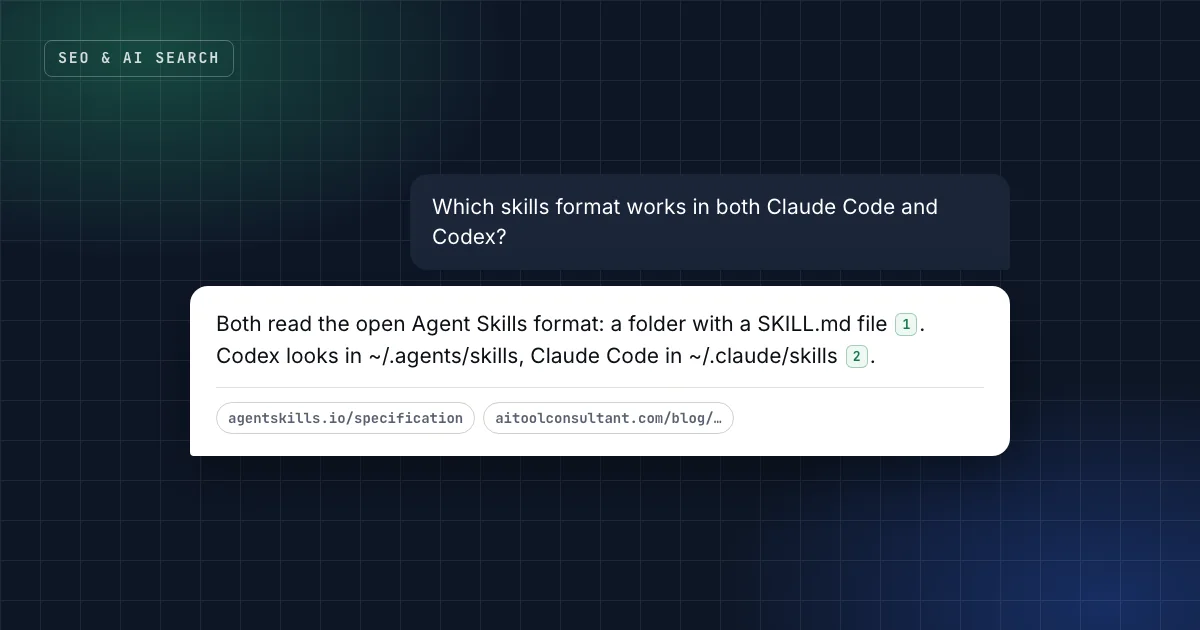
Generative engines (ChatGPT search, Perplexity, Claude with web search, Google's AI Overviews and AI Mode) don't return a list of links. They read several pages, write an answer, and cite some of their sources. GEO is about being one of the cited sources, and being cited accurately.
The 2023 paper that coined the term, "GEO: Generative Engine Optimization", was accepted at KDD 2024. It introduced a benchmark of queries and measured how different page edits changed a source's visibility in the generated answer, reporting improvements of "up to 40%".1
For Google specifically, the answer is refreshingly plain. Its documentation says: "There are no additional requirements to appear in AI Overviews or AI Mode, nor other special optimizations necessary", and "the best practices for SEO remain relevant".2 If your pages are indexed, crawlable and eligible for snippets, they're eligible. So start with SEO; Claude for SEO covers that workflow.
What does the research say actually works?
The GEO paper tested a range of page edits. The results worth acting on:1
| Strategy | Effect in the study |
|---|---|
| Cite sources | Among the best: about 30–40% relative improvement on the main visibility measure |
| Add quotations | Among the best; the strongest single method on Perplexity, about 22% over baseline |
| Add statistics | Among the best: about 30–40% relative improvement |
| Keyword stuffing | "Little to no improvement"; about 10% worse than baseline on Perplexity |
One finding is especially encouraging for small sites: "lower-ranked websites, which typically struggle for visibility, benefit significantly more from GEO". For the cite-sources method, a site ranked fifth in the search results gained 115% in visibility, while the top-ranked site lost about 30% on average.1 In AI answers, being the clearest source can beat being the biggest one.
Treat the numbers as directional: they come from a benchmark on 2023-era systems, and the paper itself notes that effectiveness varies by domain. The direction, though, matches how these systems work. A model writing an answer can quote a precise, sourced sentence. It can't do much with a vague one.
Practical takeaway
Pick your three most important pages. In each, add the primary source behind your key claim, one exact quotation from it, and one dated number. That's the GEO paper's best result in an afternoon.
Which AI crawlers should you allow?
AI companies use separate crawlers for training, for search and for fetches a user triggers, and robots.txt lets you treat them differently:
| Company | Crawler | What it's for |
|---|---|---|
| OpenAI | OAI-SearchBot | Surfaces sites in ChatGPT's search features. Sites that block it "will not be shown in ChatGPT search answers"3 |
| OpenAI | GPTBot | Crawls content that may be used to train OpenAI's models3 |
| OpenAI | ChatGPT-User | Visits pages when a user's action asks for it; robots.txt rules "may not apply"3 |
| Anthropic | Claude-SearchBot | Indexes content for search quality; blocking it may reduce visibility in Claude's search results4 |
| Anthropic | Claude-User | Fetches pages for a user's query; blocking it may reduce visibility in user-directed search4 |
| Anthropic | ClaudeBot | Collects content that could contribute to model training4 |
So you can opt out of training (block GPTBot and ClaudeBot) and still appear in AI search (allow OAI-SearchBot, Claude-SearchBot and Claude-User). Whatever you decide, decide it deliberately: a blanket "block all AI bots" rule copied from a forum can remove you from the answers your customers read.
Seven habits that make pages easy to cite
These follow from the research above and from how answer engines read pages. None of them hurts classic SEO.
- Answer first. Open each section with a one- or two-sentence answer, then the detail. Assistants quote the sentence that answers the question.
- Use the question as the heading. "What is a Claude skill?" matches how people prompt; "Overview" doesn't.
- Cite primary sources inline, with a numbered source list at the end. The paper's top method is the easiest one to adopt.1
- Quote exactly when a law, a specification or official documentation says something precisely. Mark it as a quote and link it.
- Use dated numbers ("as of October 2026") instead of "many" or "most". Undated statistics go stale silently.
- Keep key content in text, not only in images or interactive widgets. Google lists keeping important content in text form among the fundamentals for its AI features.2
- Make the entity obvious: who wrote it (an author bio with links), who publishes it (Organization structured data, an About page), and structured data that matches what's visible on the page.2
Does llms.txt help?
llms.txt is a proposal by Jeremy Howard, published in September 2024: a Markdown file at your site's root with an H1 title, a short summary in a blockquote, and lists of links to your most useful pages.5 Its authors expected it to be useful mainly "for inference rather than training", meaning when an assistant reads your site to answer a question.5
For Google, it's not needed. Google's AI features documentation says: "You don't need to create new machine readable files, AI text files, or markup to appear in these features."2 For other assistants, there's no public evidence yet that it changes citations. It takes twenty minutes to write and costs nothing to serve, so this site has one. Just don't expect it to fix pages that aren't worth citing.
How do you measure AI visibility?
There's no Search Console for ChatGPT, so measure directly:
- A fixed panel of questions. Write 15 to 30 questions your customers really ask, including ones where you should be the answer. Once a month, ask them in ChatGPT, Claude, Perplexity and Google's AI Mode, and record which sources and brands each answer cites.
- The same questions every time. Change the panel and you can't compare months.
- Referral traffic. If you run analytics, watch visits from the assistants' domains; they're small but highly intentional.
- Classic SEO metrics still matter, because for Google, AI visibility starts with being indexed and eligible for snippets.2
FAQ
Is GEO different from SEO?
It's SEO plus a few habits. Indexing, crawlability, helpful content and clear structure are the foundation for both. GEO adds attention to citable sentences, sources, quotations and the crawlers of AI search engines.
Should I block AI crawlers?
Block training crawlers if you don't want your content used for training, but allow the search and user crawlers of assistants you want to appear in. OpenAI and Anthropic document them separately, so you can make that choice per crawler.3 4
Do I need special schema markup for AI Overviews?
No. Google says no special markup is required; keep your structured data consistent with the visible text on the page.2
How long until GEO changes show up?
For Google, as long as recrawling takes, which can be days to months.2 For other assistants it depends on their own crawling and on what they retrieve at answer time, so measure monthly with the same question panel.
Sources
- GEO: Generative Engine Optimization, Aggarwal et al., accepted at KDD 2024 (arXiv:2311.09735).
- AI features and your website, Google Search Central.
- Overview of OpenAI crawlers, OpenAI documentation.
- Does Anthropic crawl data from the web, and how can site owners block the crawler?, Claude Help Center.
- The /llms.txt file, llmstxt.org, proposed 3 September 2024.
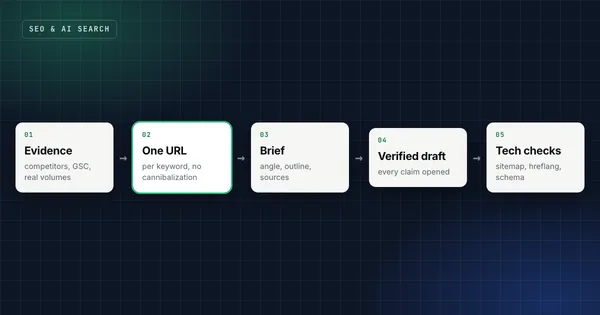
SEO & Blog Content
Keyword research from evidence, one URL per keyword, and articles where every claim has a source.
Get the free starter kit
Four complete skills for Claude, Claude Code and Codex: handover, session start, social captions and an honest exam-prep tutor. Free, so you can judge the standard.