AI Tool Consultant

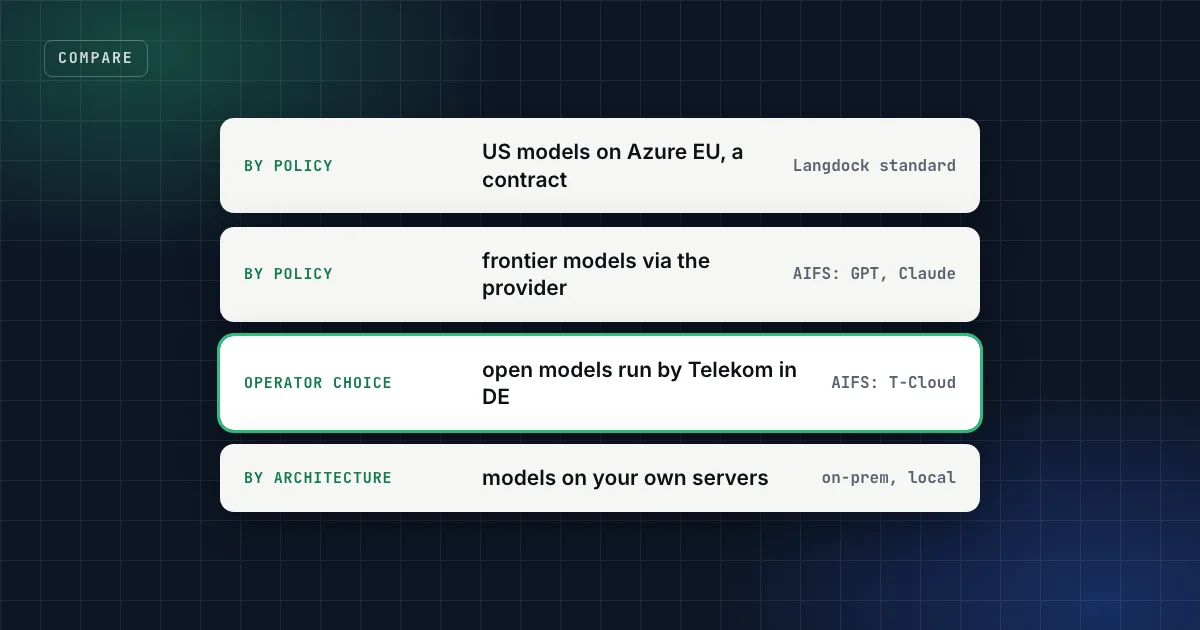
Langdock and T-Systems' AI Foundation Services (AIFS) answer the same request from European companies: "give us the good AI models, but keep our data safe." Both put dozens of models behind one interface, both stress GDPR and EU hosting, and both run some of those models on American clouds.
I tried Langdock's free version. My honest impression: a well-made wrapper. The chat, the agents and the admin settings are its own; the intelligence comes from OpenAI, Anthropic, Google and others, and a long menu of models that mostly do the same job felt more wasteful than useful. That's a matter of taste. The privacy question isn't, and it's where these two differ in a way that a feature list hides.
The short answer
- Pick Langdock if you want a ready workplace for employees (chat, agents, workflows, integrations) with EU hosting, ISO 27001 and SOC 2 reports and a data processing agreement, and you accept that in its standard setup the protection is a set of contractual promises. From €25 per user a month.
- Pick T-Systems AIFS if you're building your own tools on an OpenAI-compatible API and want a structural option: restrict yourself to open models that Telekom operates on its own cloud in Germany. It also sells a chat app, SmartChat. Usage-based pricing.
- Either way, GPT, Claude and Gemini run on Microsoft's or Google's cloud under their providers' terms. Only the open-model route changes the architecture, and only your own servers take the third party out entirely.
Privacy by policy vs privacy by architecture
The distinction comes from Sarah Spiekermann and Lorrie Faith Cranor's paper "Engineering Privacy", which I presented in a Master's seminar on AI and data protection.1
- Privacy by policy: the system collects or processes the data, and the company promises to handle it properly: a privacy notice, consent, a contract, audits. Policies can be changed, broken or misunderstood.
- Privacy by architecture: the system is built so that the sensitive data never reaches the party you'd have to trust, for example because processing happens on your own device or servers. The protection comes from the structure, not the promise.
The authors recommend notice and choice mainly where architecture can't do the job.1 For AI platforms, that turns into a spectrum:
| Level | What protects your data | Example |
|---|---|---|
| Policy | A contract with a platform that runs US-made models on a US company's cloud in an EU region | Langdock's standard setup; AIFS's GPT and Claude models |
| Operator choice | Open models run by a European operator on its own infrastructure; the model's maker never sees your data | AIFS's models on Telekom's cloud in Germany |
| Architecture | The model runs on servers or devices you control | Self-hosted open models, like the local setup in my Gemma vs Mistral vs Qwen tests |
The middle level is still a cloud: you trust Telekom instead of OpenAI or Microsoft. But it removes a whole party from the data path, which a contract can't do. (I wrote about the same idea for product teams in usable privacy in AI.)
Langdock vs AIFS at a glance
| Langdock | T-Systems AIFS | |
|---|---|---|
| What it is | A workplace AI platform: model-agnostic chat, agents, workflows, integrations, API2 | An OpenAI-compatible model API ("LLM Serving"), plus SmartChat, a chat app5 6 |
| Built for | Employees across a company | Developers and IT teams building their own tools |
| Models | Models from OpenAI, Anthropic, Google, Meta, Mistral and DeepSeek4 | Over 30 models: open-source models hosted by Telekom, frontier models from OpenAI, Anthropic, Google and Mistral5 |
| Where the models run | "The application and most models (configurable) are hosted entirely in the EU"; standard SaaS on Microsoft Azure in the EU3 | Open models on Telekom's T-Cloud in Germany; closed models forwarded to their providers on Microsoft Azure or Google Cloud6 |
| Can you keep data off US providers? | Not in the standard multi-tenant setup; dedicated, own-cloud and on-premise deployments start at 2,000 to 5,000 seats3 | Yes: restrict the catalogue to Telekom-operated models in Germany5 |
| Certifications named | ISO 27001, SOC 2 Type II, GDPR, no training on customer data3 | T-Cloud: BSI C5 Type 2 and ISO 27001; GDPR with a German contract partner5 |
| Price | 7-day free trial; Business from €25 per user a month (€99 for a "Max" seat with five times the usage); Enterprise on request2 | Free trial key; token-based plans (Essential, Professional, Agentic); SmartChat at a monthly flat rate agreed per users and storage. No list prices on the pages I read6 |
Where your data goes
Langdock. The standard product is multi-tenant software "hosted via Microsoft Azure on servers inside the EU", and Langdock says customer data is never used to train models, is encrypted in transit and at rest, and is covered by ISO 27001 and SOC 2 Type II audits.3 Those are serious controls, and an independent test describes the data as stored in Frankfurt.8 But look at who sits in the path: a Berlin company,8 Microsoft's cloud, and model makers that are mostly American (OpenAI, Anthropic, Google, Meta), plus Mistral and DeepSeek.4 What keeps your prompts in Europe and out of training data is their agreements with each other and with you. That's privacy by policy, done carefully. Dedicated deployments in your own cloud or on your own Kubernetes cluster exist, from 2,000 or 5,000 seats.3
T-Systems AIFS. AIFS splits its catalogue in two, and says so plainly. Open-source models (Gemma, Mistral Small, Qwen, GPT-OSS and others) are operated by T-Systems on its own T-Cloud in Germany; closed models are forwarded to their providers on Microsoft Azure or Google Cloud, "operated by the respective provider under its own terms".5 6 You can restrict your teams to the first group. That doesn't make it local: your data still leaves your network, and you trust Telekom. By AIFS's own description, though, it takes the American model providers and hyperscalers out of the data path for that work: a change in structure, not another promise.
The wrapper question
Both companies sell bundling as the point. AIFS describes the problem as "Ten pilots. Ten stacks." and offers one contract and one API for every model;5 Langdock calls its chat "model agnostic, for everyone in the company".2 For a legal department, one data processing agreement instead of five is real value.
My objection is practical: when I tried Langdock, the long list of models mostly did the same thing, and picking between them added work without adding much. If you buy a bundle, decide on two or three models for defined jobs, and route sensitive work to the most structural option you have, instead of offering everything to everyone.
What other reviewers say
- Thoughtworks' Technology Radar (November 2025, "Trial") describes Langdock as a platform for internal agents and workflows that emphasises data sovereignty with on-premise and EU-hosted options, and still advises close attention to data governance, the platform's maturity and the integrations you need.7
- bakedwith's test (September 2026), from an AI automation agency, concludes that data protection and model choice speak for Langdock. It also documents fair-use limits on the standard seat, with optional extra usage billed at API prices up to a default cap of €1,000 a month.8
- AIFS: I didn't find an independent review. Telekom launched it in February 2025.9
Both Langdock reviews rate its privacy setup highly, and on the policy side they're right: the paperwork is thorough. The question this page adds is the one from the seminar: thorough paperwork is still policy.
Not legal advice
This page compares architectures, not legal compliance. Whether a setup meets your GDPR obligations depends on your data, contracts and risk assessment. Please assess your specific case, ideally with your own counsel.
FAQ
Is Langdock GDPR compliant?
Langdock says it's aligned with the GDPR, offers a data processing agreement, hosts its standard product on Microsoft Azure in the EU, and holds ISO 27001 and SOC 2 Type II. Whether your use is compliant depends on your setup and data; the protection in the standard product rests on contracts and audits rather than on keeping the data away from US companies.
Where does Langdock store data?
On Microsoft Azure servers inside the EU for its standard multi-tenant product, and "most models (configurable)" are hosted in the EU, according to Langdock. An independent test describes the data as stored in Frankfurt. Dedicated, own-cloud and on-premise deployments are available for large organisations.
Is Langdock just a wrapper?
It builds its own chat, agents, workflows, integrations and admin controls, and the models come from OpenAI, Anthropic, Google, Meta, Mistral and DeepSeek. When I tried the free version, it felt like a wrapper: useful packaging around other companies' models, with more model choice than most teams need.
What are T-Systems AI Foundation Services?
Deutsche Telekom's AI platform for companies: an OpenAI-compatible API to more than 30 models, open-source models operated by T-Systems in Germany and frontier models forwarded to their providers, plus SmartChat, a chat app for employees.
What's the difference between privacy by policy and privacy by architecture?
Privacy by policy protects data with promises: notices, consent, contracts and audits. Privacy by architecture designs the system so that sensitive data never reaches the party you'd otherwise have to trust. The terms come from Spiekermann and Cranor's 2009 paper "Engineering Privacy".
What's a Langdock alternative with stronger privacy?
Within this comparison, AIFS restricted to Telekom-operated models in Germany. Stronger still is running open models on your own infrastructure; my local model tests show what that looks like on a single laptop. For the big assistants' own team plans, see ChatGPT vs Claude vs Gemini vs Copilot.
Sources
- Sarah Spiekermann and Lorrie Faith Cranor, Engineering Privacy, IEEE Transactions on Software Engineering 35(1), 67-82, 2009.
- Pricing, Langdock (read 2 Nov 2026, prices excluding VAT).
- Security, Langdock (read 2 Nov 2026).
- Models, Langdock documentation.
- LLM Serving, T-Systems AI Foundation Services (read 2 Nov 2026).
- FAQ, AI Foundation Services documentation (read 2 Nov 2026).
- Langdock, Thoughtworks Technology Radar (November 2025).
- Langdock im Test, bakedwith (25 Sep 2026, in German).
- T-Systems launches AI Foundation Services for enterprises, Deutsche Telekom (February 2025).
Get the free starter kit
Four skills that work in Claude, Claude Code and Codex alike: handover, session start, social captions and an honest exam-prep tutor. Free, so you can judge the standard.