AI Tool Consultant

"In my head I'm already C1, but my mouth refuses to move." I said that after a job interview in German in September. My prepared introduction had been error-free; the three sentences I improvised afterwards contained every one of my main mistakes. That gap, between knowing German and producing it under pressure, is what most people who learn German with AI actually need help with, and it's not what most AI tools are built for.
From late July to October I kept an almost daily German journal, mostly handwritten, corrected with Claude. I also kept a second file: every time a method helped or failed, it got a row with the date and the evidence. Guesses went into a separate "to test" list. This is what that file says.
At a glance
- Start every session with yesterday's mistake, as one sentence, spoken, without looking. It was the form of repetition that actually worked.
- Use your real work as material: emails, meeting notes, interview prep. Three days of work texts in a row with no motivation problems; course drills got abandoned.
- Find your own mistakes before seeing the solution. Two-phase correction: hints first, your attempt, then the answer.
- Correct, don't rewrite. A minimal change keeps your style. Translators and chatbots that rewrite whole sentences erase it.
- Rehearse 3–4 sentences right before the real conversation. Every rehearsed correction held under pressure in a real interview.
What helped: the evidence
Each of these is backed by a dated observation in the journal, not by a feeling.
| What helped | The evidence |
|---|---|
| Yesterday's sentence, spoken, without looking it up | On 8 September I couldn't produce daran arbeiten or deswegen. On 9 September, after starting with them, both came out correctly and freely. |
| Real work texts instead of course material | Three days in a row with meeting tasks, a work email, a contract and a company profile: no motivation problems, and the mistakes surfaced by themselves. |
| Writing about my own field | A text about SQL joins produced my best self-correction score in weeks (6 of 9 on the items I worked on). |
| Rehearsing right before the real thing | Before a job interview, I rehearsed four sentences 45 minutes earlier. All four corrections held under pressure. |
| Finding my own mistakes first | When I did the self-correction phase: 15 of 19, 11 of 18 and 15 of 21 mistakes found before seeing the solution. |
| Ending rules instead of single words for gender | -ung, -heit, -keit, -schaft and -tur are feminine: one rule, applied correctly to new words like meine SQL-Prüfung. |
| Lots of real use moves sentence structure | Inversion after an adverb went from 2 right and 5 wrong (18 August) to 10 right and 3 wrong (mid-September), with no drill in between. |
| Keeping my own style | My own rule from August: if every correction gives me a different version, my style is gone. Corrections now change only what's wrong. |
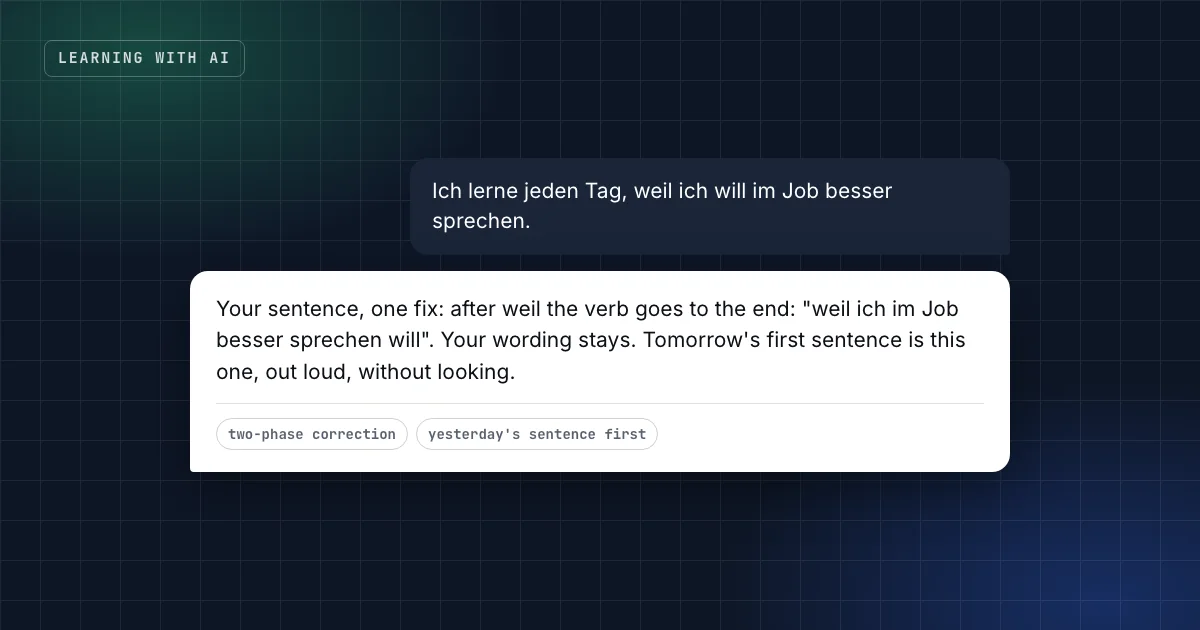
| Counting mistakes over weeks | Patterns like weil with the verb in the wrong place (43 times) and missing capital letters when typing (62 times) only became visible because they were counted. |
What didn't help (or not on its own)
| What didn't work | The evidence |
|---|---|
| Knowing the rule | weil sends the verb to the end. I knew that. Nine mistakes in three days, one of them typed calmly, hours after reading the rule. Explanation isn't the bottleneck; retrieval under time pressure is. |
| Long task lists | Lists of 17 or 20 corrections got abandoned halfway. When I asked for the solution without trying first, there was no measurable learning effect. |
| Homework "for later" | A drill assigned in August was never touched. Anything that matters has to happen inside the session. |
| Dodging to easier forms | Three documented times I replaced the form I was practising with an easier one. Progress looks better than it is unless the tutor notices and says so. |
| Dictation tools as input | A dictation app silently fixed ten mistakes in one entry: gender, accusative, word order. Corrected input can't show you your errors. |
| Prepared ≠ spontaneous | The prepared interview introduction was perfect; the improvised sentences weren't. They need separate practice and separate measurement. |
Practical takeaway
If you use an AI tutor, give it raw input: handwriting photos, typing without autocorrect, or audio transcribed in a way that keeps mistakes. A tool that quietly fixes your text before the tutor sees it removes the very thing you're trying to learn from.
Why repetition felt so hard, and the form that worked
In early October I wrote down something uncomfortable: correction and repetition exercises made me deeply unmotivated, and it wasn't about the language. The data agreed. Every abandoned session in the journal was a correction or repetition phase; none was a writing or speaking phase.
But one form of repetition had worked: a single sentence from the day before, spoken aloud, about my own life. So the problem wasn't repetition itself; it was its form. Two small measurements (I rated each piece of practice from 1 to 5 for how much I wanted to do it) pointed the same way:
- Production beat correction. Writing my own sentences with a new phrase got a 4; a correction task got a 2, even though it took ten seconds to solve.
- Yesterday's sentence, two days later, got a 5, the highest rating so far.
- Length mattered as much as form. In my own words: five-minute pieces kept my motivation at 3 or 4; twenty-minute pieces dropped it to 1. Six pieces of five minutes were sustainable.
These are small samples from one learner, and I treat them as directions, not laws. They're consistent with what learning research calls desirable difficulties: retrieving something feels harder and slower than rereading it, and works better for remembering, as long as you have enough background to succeed at it.1
The routine that came out of it
- One sentence from yesterday's mistakes, spoken, without looking. Thirty seconds.
- Produce something real: a short journal entry, an email you actually need to send, notes for a meeting.
- Two-phase correction. The tutor marks real errors with hints but no solutions. You try. Then the tutor gives the answers, the full list and a corrected version that keeps your wording.
- Pieces of five minutes or less, in a round with a fixed end. Five or six pieces, then stop.
- Before an important conversation, rehearse three or four sentence openings you'll need. Ten minutes before is enough.
- Keep a running error file with counts per pattern, so the next session knows what to retrieve.
Setting up Claude (or ChatGPT) as a German tutor
You can run this routine in any capable assistant with a project or custom instructions. The instructions that matter most:
- "Mark my errors with hints, never with the solution, until I've tried."
- "Change only what's wrong. Keep my words and my style."
- "Count my error patterns in a file and start tomorrow with one sentence from them."
- "If I avoid the form we're practising, say so."
- "Never credit a construction I avoided as a correct use."
The last two are the ones general tutors skip, and they're exactly where progress gets overstated. The Learn German pack on this site turns this method into skills: a two-phase writing corrector that tracks patterns over weeks, a coach built from the evidence log above, a speaking coach for voice notes, and bilingual karaoke subtitles for videos of yourself speaking.
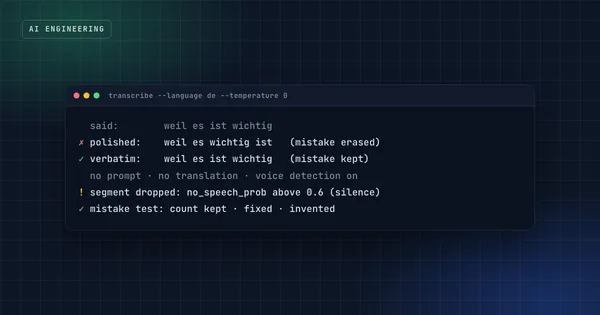
For speaking practice, the transcription step needs care, because most speech-to-text quietly repairs your grammar. That problem and its fix are in speech-to-text for language learners.
FAQ
Can you learn German with ChatGPT or Claude alone?
You can get far, especially at B1 to C1, if the tutor makes you retrieve and produce rather than read explanations. It won't replace speaking with people; the gap between prepared and spontaneous speech needs real conversations. If you're choosing between the two, ChatGPT vs Claude compares what each plan includes.
Is AI correction better than a teacher?
It's more available and more patient, and it can count your mistakes over weeks. A good teacher is better at noticing when you're dodging, unless you instruct the AI to watch for it.
How long should a daily session be?
In my log, rounds of five or six pieces of up to five minutes each worked. Longer pieces killed motivation, and motivation is what keeps a daily routine alive.
What level is this method for?
It was built at B2 to C1, with handwritten journal entries, work emails and interview preparation. The principles (retrieval, real material, minimal corrections) apply earlier too, with simpler texts.
Sources
- Making things hard on yourself, but in a good way: creating desirable difficulties to enhance learning, E. L. Bjork and R. A. Bjork, 2011, Bjork Learning and Forgetting Lab, UCLA.
Learn German with AI
The daily method behind months of measured German progress, as skills Claude can run for you.
Get the free starter kit
Four complete skills for Claude, Claude Code and Codex: handover, session start, social captions and an honest exam-prep tutor. Free, so you can judge the standard.